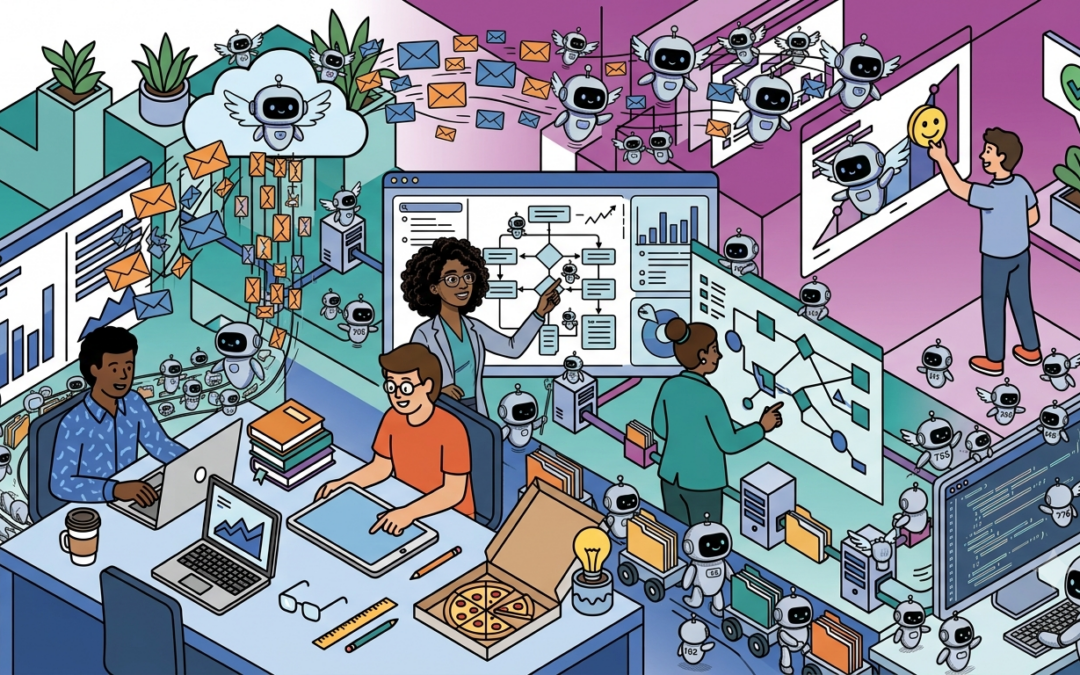
We have a saying at SocialOptic: “a few smart people and a thousand robots.” Initially, you might hear us using it to explain the automation behind our products, but it has a deeper, more significant meaning too; it’s a phrase which encapsulates our attitude towards technology and the way we approach work. Rather than automation being a way of replacing people, it’s actually about putting them at the heart of the business.
Automation: say hello to the robots
Automation has been happening for decades. A thermostat used to control a boiler. A machine packaging biscuits in a factory. They all reduce human intervention in a process and both are forms of automation. In the technology sphere, Generative AI is actually just another form of automation, or think about a much simpler form of automation: the autocomplete on your phone or in your emails.
Boring, repetitive tasks are where humans are most likely to make mistakes. Complex, novel tasks are where AI is most likely to make mistakes. If you put the machine where humans fail and the human where machines fail, you’ve designed the system properly rather than replaced anyone.
Take the car industry as an example. It was among the first to bring in the large-scale, commercial use of physical robots to build cars back in the 1960s. There was a lot of fear that it would lead to job losses, but that wasn’t what happened; what happened was product innovation. We got a higher standard of quality and dozens of new features and capabilities that we take as standard today. Toyota’s approach started with a loom built so that it stopped itself the moment a thread broke. Before, the loom carried on weaving cloth with a borken thread until someone noticed, so someone had to watch it. Afterwards, one worker could run thirty or forty at a time, because the machines only asked for a human when they hit something they couldn’t handle. Toyota called it jidoka: automation with a human touch, where the machine stops itself when something goes wrong and a person decides what to do about it.
At SocialOptic, where there are repetitive tasks, we automate them. We wouldn’t have someone send out a thousand individual survey invitations by hand, we’d use a robot to automate the job. These aren’t physical robots with arms, but small pieces of software which have set tasks (although we like to think of them rather affectionately as ‘robots’ and have even given many of them names). We literally have thousands of them. They help us write code, they make sure our websites are running properly, they review information coming into the platforms. They do a lot of the heavy lifting for us: from small repetitive tasks to things it would take a human a very long time to do.
The benefits of automation
If you wanted your international survey broken down into a hundred country-specific reports, rather than have one person spend a week cutting and pasting into an Excel spreadsheet, our robots produce them in seconds as a tidy folder of reports. Not only that, the reports will have a degree of consistency that surpasses what a human can sustain. There are benefits in automation. The reasons for that are two-fold: robots are better than humans at doing one task consistently. Importantly, to automate something, means understanding and documenting the process. That then means that, alongside the robot carrying out that task, we can have others making sure that the task is completed effectively, and looking for opportunities for improvement. The benefits of this for our customers are obvious: they get faster, more consistent results. The benefit for us is that it frees us up to do other things. And that is where the real beauty of automation lies.
Automation improves productivity and pushes up quality
If you’ve read our blog on closed-loop processes you might recognise the pattern of work described. Automation creates the capacity to drive the continuous improvement cycle. For us, automation means we can take a step back, look at the whole system and take stock of what the robots are producing. For our customers, it means we can then advise and work with them to determine what this information means for their business. What do they need to change as a result of what they now know? It allows them to improve and sometimes transform the way they work. Applied more widely, automation does mean jobs will change and people will have to learn new skills. But once they’ve rid themselves of those repetitive tasks, they should have more satisfying, interesting jobs as a result.
Automation makes people more valuable
When time is freed up by automation to enable people to do other jobs, it is the human behind the robots that ends up doing the ‘smart’ work, the strategically valuable thinking. Even in the case of AI. People make the decisions about what the robots do, and they take responsibility for those decisions. The robots just do, even if the robot appears to be making a decision. It is people who are central to success, and that is something that has meaning far beyond automation. Having the people in your organisation working in an environment which is well adapted to their needs, and making sure they have the right support, is what will make your processes (which may or may not be carried out by robots) work effectively.
Culture beats, or breaks, automation. GM’s Fremont plant ran from the sixties to the early eighties. By its end, absenteeism was over 20% on some shifts, deliberate sabotage was common, and it was characterised by consistently poor quality. GM closed the plant in 1982. Two years later GM and Toyota reopened it, with most of the same workforce, and it became one of the best plants in the GM system. There were no significant new robots. It was the same building, the same people, but a different approach.
A few smart people and a thousand robots
The value of having “a few smart people and a thousand robots” is not the thousand robots doing their tasks, it is in having the smart people who can create the right systems and processes. We like to think the order of importance is this: people, then processes, systems and assets. Not assets, processes and then fitting some people in around them. And that’s why, when customers hear us use this phrase, it’s always “a few smart people and a thousand robots” and never the other way round.